Mission, Vision & History
The Museum of Costume Jewelry is a registered 501(c)(3) nonprofit (EIN: 82-1979136), and our story is just getting started.
Mission
To collect, preserve, research, and exhibit 20th Century and contemporary costume jewelry designers through a variety of programs, including museum exhibits, publications, lectures, oral and visual history, and adult and children's educational activities.
Vision
To be a home where costume jewelry is seen, celebrated, and understood as the art form it is, inspiring Western North Carolina's thriving creative community and drawing visitors from around the world as an international destination for this singular art form.
Looking ahead
Our lecture series, Collectors Club, and other educational programming are already bringing people into the museum's story. We're building a digital archive of lectures by noted jewelry authors and historians, so that knowledge lives on beyond a single evening. K-12 school tours connect the next generation to this history. And we're growing a collaboration with UNC Asheville, where students are working alongside us on archiving, curation, and marketing. This is just the beginning of how we share, and grow, this collection together.
History
Founder Sharon Ryback spent more than two decades building the collection before the museum ever opened its doors, researching and authenticating each piece by hand along the way. Visits to museums across the United States and Europe helped her understand exactly what she wanted to build, and a stop at Amsterdam's Museum of Bags and Purses, formed entirely from one woman's personal collection of more than 4,000 handbags, became the spark that turned a private passion into a public plan.
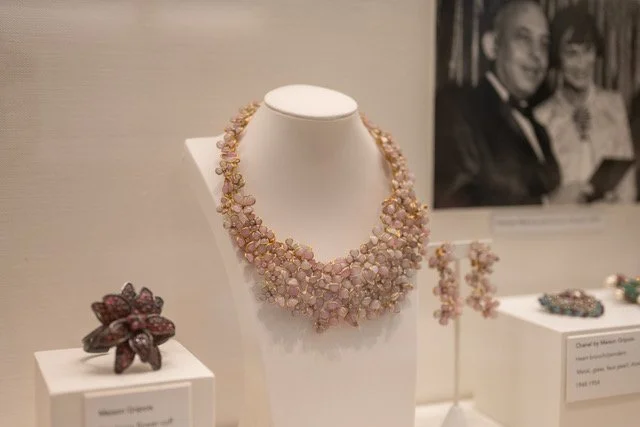
Sharon and her husband and partner in this work, Eric Ryback, found their way to Asheville drawn by its deep-rooted arts community and the millions of visitors who pass through the region each year, a natural home for a museum built around craftsmanship and creative expression. In time, Sharon left a long career to pursue the museum fully. She and Eric spent months transforming a space on Haywood Street. Sharon researching and labeling every piece in the collection, Eric installed each exhibit, including the museum's signature floating necklace display, which allows necklaces to appear suspended in midair.
Preservation remains at the center of that work today. Historic costume jewelry is increasingly lost to the market. Parures, matched sets meant to be worn together, get split apart and sold off piece by piece. Individual pieces get reproduced and passed off as originals. Every piece in this collection was saved from that fate.
Sharon's path to the museum wasn't only about jewelry. Her years as a psychiatric clinical nurse specialist shaped how she thinks about connection, memory, and care. That perspective now shapes how the museum puts its collection to work beyond exhibits alone, including The Locket Project, a pilot reminiscence program being developed in collaboration with community partners to use jewelry as a spark for memory and conversation among older adults living with memory loss and the caregivers who support them. What began as two separate callings, nursing and collecting, have come together in a single mission: using the artistry of costume jewelry to connect, and to care.